Sunnbüel Cable Car and the Gemmi Trail Over to Valais
The Sunnbüel cable car lifts you from Kandersteg to the start of the Gemmi Pass trail to Leukerbad. The walk is one-way, and the return loop takes planning.

The One Crossing Everyone Gets Wrong
The Gemmi Pass crossing from Kandersteg to Leukerbad is not a loop. It is a one-way hike with a 2.5-hour bus and train return that catches walkers who only figure out the logistics after they have already walked off the mountain. By then, the last connection from Leukerbad has left. A taxi for the 140 km drive back costs a few hundred francs, if you can find one. The thermal baths are not an option because you are stuck on the wrong side of the pass.
The Sunnbüel cable car and the Gemmi trail close from mid-April to mid-June and again from late October. This is a July-through-September walk. Outside those months the trail is snowed under or the lift is shut. Plan the return before you buy the cable car ticket, not after you reach the Gemmi.
How the Day Works
The crossing works exactly once per day. Ride the Sunnbüel cable car from Kandersteg village at 1,176 m up to the Sunnbüel shelf at 1,934 m. Walk 6 km across the high ground, past the Schwarenbach hotel at 2,061 m, along the shore of Daubensee at 2,205 m, and up to the Gemmi Pass at 2,314 m. Then descend 900 vertical metres on a historic mule track into the Valais, arriving in Leukerbad at 1,402 m roughly four hours after you started walking. From Leukerbad take a bus to Leuk station, a train to Visp, a change for Spiez, and a final train to Kandersteg. That loop takes 3 to 3.5 hours. Start walking from Sunnbüel at 10:00, reach Leukerbad around 14:00, and you are back in Kandersteg around 17:30. That is the only realistic same-day schedule. Start later and you miss the last bus out of Leukerbad.
- Cable Car Operating Period (Summer 2026): 17 May to 19 October, subject to change. Published by Luftseilbahn Kandersteg, Sunnbüel AG.
- Cable Car Operating Period (Winter 2026/27): 20 December to 15 March, subject to change. Published by the same operator.
- Cable Car Journey: 8 minutes, 758 m vertical rise, 1,960 m length, 40-person gondola.
- Sunnbüel to Gemmi Pass Walk: 6 km, 2 to 2.5 hours, 380 m ascent.
- Gemmi Pass to Leukerbad Descent: 900 m vertical drop, approximately 2 hours on foot.
- Return Journey Leukerbad to Kandersteg by Train: 3 to 3.5 hours via Leuk, Visp, Spiez.
- Return Journey by Road: 140 km, 2 hours 15 minutes to 2 hours 45 minutes driving.
- Sunnbüel Plateau Elevation: 1,934 m. Typically 6 to 10 °C colder than Kandersteg village at 1,176 m.
What You Walk Through on the Gemmi Trail
From the Cable Car to Schwarenbach
Step off the Sunnbüel cable car onto a panorama terrace facing the Doldenhorn massif. This is the only flat ground you will see for the next two hours. Use it. Check your gear, put on a wind layer, and confirm your offline map is loaded. There is no phone signal on most of the crossing. Swisscom has 4G in Kandersteg village and at Oeschinensee. The Gasterntal and Griesalp have zero signal. The Gemmi high ground has none. Download the SBB timetable and the trail map before you leave Spiez.
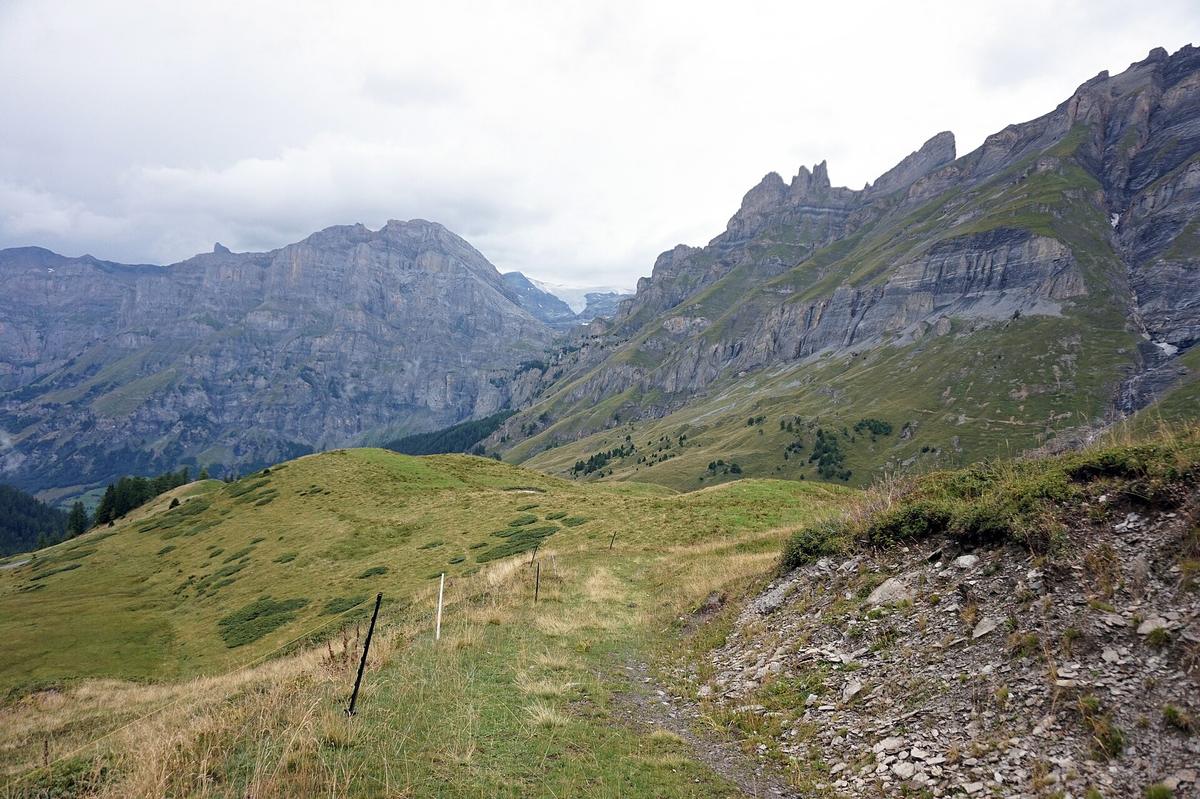
The trail runs east toward the Schwarenbach hotel, a small stone building at 2,061 m that has been sheltering travellers since the 19th century. From Schwarenbach the path bends south and follows the western shore of Daubensee. The lake sits at 2,205 m in a wind-scoured basin with no trees and no vegetation above knee height. The water is grey-green and cold even in August. On a clear day the Valais peaks beyond the pass look close enough to touch. On a cloudy day the lake disappears into the mist and the trail markers are your only anchor. Walkers who underestimate the exposure here get caught without enough layers. The high ground is 6 to 10 °C colder than Kandersteg village and the wind has no obstruction.
The Final Ascent and the Descent
The last 380 m of climb from the lake to the Gemmi Pass at 2,314 m is the steepest section. This is the historic mule track, a broad stone-and-gravel path built for pack animals carrying salt and goods between the Bernese Oberland and the Valais. The gradient is relentless but not technical. No scrambling. No exposed ledges. No via ferrata sections. You need sturdy boots and trekking poles for the descent into Leukerbad, which drops 900 m over two hours on loose stone and switchbacks. The path is well maintained but the surface is uneven and the knees take a beating.
The Return Problem and How to Solve it Before You Start
Most walkers treat the return as an afterthought. It is not. The loop back to Kandersteg via public transport takes 3 to 3.5 hours and runs on a sparse schedule. Leukerbad bus departures to Leuk station are hourly at best. Miss the 16:30 connection and the next bus is 17:30, which means you miss the train connection in Leuk and add another hour. The last bus from Leukerbad in summer leaves around 18:30. After that, the only option is a taxi for the 140 km drive over the Lötschberg pass or through the car-train tunnel. Do not count on that taxi existing. The valley has no taxi backup.
The Correct Plan
Buy a return cable car ticket from Kandersteg to Sunnbüel, not a one-way ticket. Ride up at 09:00. Walk the Gemmi. Descend to Leukerbad. Take the 15:00 or 16:00 bus to Leuk. Train from Leuk to Visp, change for Spiez, then to Kandersteg. Arrive around 17:30 to 18:30. If you want the Leukerbad thermal baths, do them on a separate day. Adding a soak to the crossing means you miss the last bus. The baths are open until 20:00 but the bus schedule does not cooperate.
Walk It in Reverse
One alternative exists: walk the Gemmi backwards. Start in Leukerbad, ride the Gemmi cable car from the Valais side up to the pass, walk back across the high ground to Sunnbüel, and descend by cable car to Kandersteg. This solves the return problem because you end where you started. But the Gemmi cable car on the Leukerbad side has the same shoulder-season closures as the Sunnbüel lift. It runs from mid-May to late October. Outside that window the reverse route is not possible. And the trail direction means you climb the steep 900 m from Leukerbad to the pass first, then have a long descent across the open shelf. Most hikers prefer the ascent on the Sunnbüel side because it is gentler.
The Reward at Either End
Rösti with melted Raclette du Valais at the Sunnbüel mountain station is the meal that finishes the day, whether you start or end there. The station serves it on a wooden board with cornichons and pickled onions. It is the only hot food on the mountain and costs around CHF 20 to CHF 25; check the operator's menu for the current price. Eat it before the descent if you are walking to Leukerbad. Eat it after the return if you came back from the Valais. The terrace faces the Doldenhorn and the sun hits it until mid-afternoon in summer.
On the Leukerbad side the reward is the thermal baths, but only if you stay overnight. The same-day crossing leaves no time for the baths. Book a room in Leukerbad, soak in the thermal water, and return to Kandersteg the next morning. That changes the calculus completely. You walk down into the Valais, sleep at 1,400 m, and take a relaxed bus and train back the next day. Admission runs CHF 25 to CHF 35 depending on which complex you choose; check the Walliser Alpentherme and Burgerbad websites for exact rates. Both are open until 20:00 or 21:00.
The Gemmi crossing is not a casual afternoon walk. It is a full-day commitment on an exposed high alpine trail with a complicated return. The people who enjoy it most treat the logistics as seriously as the hiking. The people who hate it thought they could walk down into Leukerbad and simply turn around.

When the Crossing is Not Worth Doing
If you have only one day in Kandersteg, skip the Gemmi crossing. Do Oeschinensee instead. The Oeschinensee cable car queue in July and August can exceed 90 minutes from 10:00, but arrive before 09:00 and you clear the wait. The lake walk is flat, the Berghaus serves Älplermagronen with apple sauce at 1,678 m, and you are back in Kandersteg by 14:00. The Gemmi crossing consumes the entire day plus the return loop and leaves no margin for error. One day in Kandersteg is not enough for two high-altitude objectives. The valley is linear but the side branches are dead ends. Each one consumes a full day. You cannot shortcut between Oeschinensee, the Gemmi, the Gasterntal, and Griesalp without returning to the valley floor.
If the weather forecast shows clouds building after 12:00, do not start the crossing. The high ground has no tree cover above 1,800 m and the wind is constant. The temperature difference between the open shelf and Kandersteg village is 6 to 10 °C. A clear morning does not guarantee a clear afternoon. The Gemmi Pass is a wind funnel and the descent to Leukerbad becomes dangerous in wet conditions because the stone track turns slippery. One cancelled cable car in the afternoon because of thunderstorms leaves you on the Leukerbad side with no quick way back.
The Gemmi crossing is a specific walk for specific travellers. It rewards preparation and punishes improvisation. Read the bus timetable. Carry cash. Wear boots you have broken in. Accept that the return takes as long as the walk itself. Then the crossing delivers exactly what it promises: a historic mule track across a bleak lake basin with Valais peaks on the far side. If you expect a casual afternoon with a thermal bath at the end, it delivers a 2.5-hour bus ride instead.
Common Questions
Can I do the Gemmi crossing in winter?
The Sunnbüel cable car runs in winter from 20 December to 15 March, and the high ground has marked winter walking trails, but the Gemmi Pass trail itself is not maintained or marked in winter. Avalanche danger is serious and the descent to Leukerbad requires winter mountaineering equipment and experience. The winter trail on the Sunnbüel shelf is a 4 km circular route, not a crossing.
What is the earliest I should start the walk?
Take the first cable car of the day. In summer that is usually 08:00 or 08:30 depending on the operator's published schedule. Starting at 09:00 gives you a comfortable pace to reach Leukerbad by 13:30 to 14:00 and catch the bus before 16:00.
Do I need cash on the trail?
Yes. The Schwarenbach hotel accepts cash but card terminals are unreliable above 1,500 m. The Sunnbüel mountain station takes cards but carry cash in Swiss francs for food and emergencies. The bus from Leukerbad requires coins or the SBB Mobile app. Drivers do not sell tickets.
What happens if the weather turns bad on the plateau?
There is no shelter between Schwarenbach and the Gemmi Pass. Daubensee has no hut. If thunderclouds build, turn back to Sunnbüel immediately. The high ground is exposed and lightning risk is high. Check the MeteoSwiss forecast for the 2,000 m level, not the Kandersteg village forecast, before you buy your cable car ticket.
Is this walk suitable for children?
Children aged ten and up who are strong walkers can manage the 6 km plateau section. The 900 m descent to Leukerbad is harder on young legs and knees. Families with children under eight should walk only the Sunnbüel shelf and return by cable car. The 4 km circular winter trail is manageable for younger children in good snow conditions.
Read next
-
 Oeschinensee
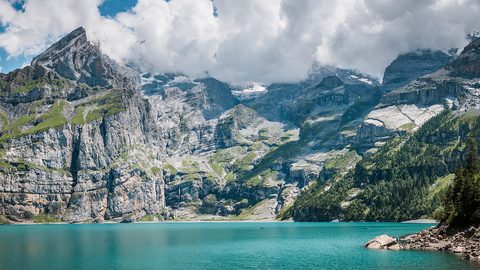
The turquoise Oeschinensee under sheer cliffs is the Kandertal's UNESCO centrepiece—here's how to beat the cable car queue and walk the full circuit safely.
Oeschinensee
The turquoise Oeschinensee under sheer cliffs is the Kandertal's UNESCO centrepiece—here's how to beat the cable car queue and walk the full circuit safely.
-
 Gasterntal
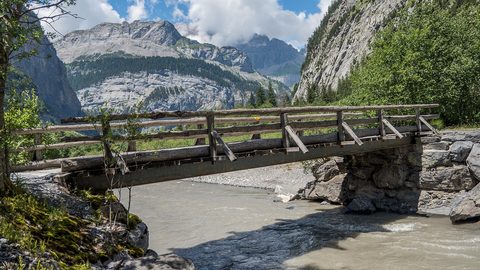
The Gasterntal is a dead-end glacial valley behind Kandersteg with a controlled single-lane road, no phone signal, and a historic timber hotel. Here’s how to get in.
Gasterntal
The Gasterntal is a dead-end glacial valley behind Kandersteg with a controlled single-lane road, no phone signal, and a historic timber hotel. Here’s how to get in.
-
 Allmenalp
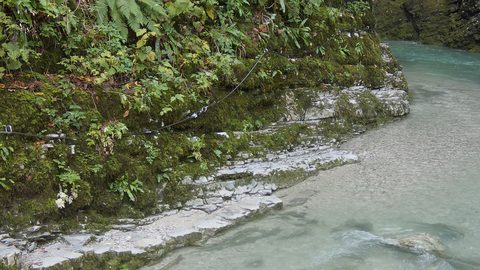
The Allmenalp cable car above Kandersteg serves a via ferrata, a climbing crag, and a paraglider launch. It’s not a general viewpoint, and it shuts in the shoulder seasons.
Allmenalp
The Allmenalp cable car above Kandersteg serves a via ferrata, a climbing crag, and a paraglider launch. It’s not a general viewpoint, and it shuts in the shoulder seasons.
-
 Kandertal Hotels and Mountain Inns Worth Booking
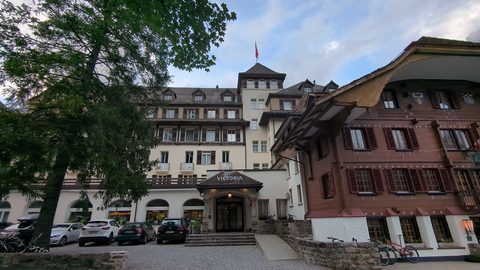
From the timber rooms of the Waldhaus in the Gasterntal to a dormitory bed at the Oeschinensee mountain hut, here are the Kandertal's real hotel options.
Kandertal Hotels and Mountain Inns Worth Booking
From the timber rooms of the Waldhaus in the Gasterntal to a dormitory bed at the Oeschinensee mountain hut, here are the Kandertal's real hotel options.
-
 Where to Stay in the Kandertal Valley for Hiking and Quiet
Compare the three places to sleep in the Kandertal—Kandersteg village, the Kiental farms, and the high hamlet of Griesalp—and find the right base for your hiking trip.
Where to Stay in the Kandertal Valley for Hiking and Quiet
Compare the three places to sleep in the Kandertal—Kandersteg village, the Kiental farms, and the high hamlet of Griesalp—and find the right base for your hiking trip.
-
 Things to Do in the Kandertal Summer Hiking and Winter Ski Touring
What there is to do in the Kandertal, split between summer hiking and winter ski touring, with the dead shoulder seasons clearly marked so you do not arrive to closed lifts.
Things to Do in the Kandertal Summer Hiking and Winter Ski Touring
What there is to do in the Kandertal, split between summer hiking and winter ski touring, with the dead shoulder seasons clearly marked so you do not arrive to closed lifts.
-
 Best Time to Visit the Kandertal and When to Stay Away
The Kandertal has two real seasons—high summer hiking and late-winter ski touring—and two long shoulder closures when the cable cars and huts simply shut.
Best Time to Visit the Kandertal and When to Stay Away
The Kandertal has two real seasons—high summer hiking and late-winter ski touring—and two long shoulder closures when the cable cars and huts simply shut.
-
 Getting Around the Kandertal Without a Car
The Kandertal runs on PostBuses with early last departures and no taxi backup. Learn the Gasterntal road rules, the SBB app, and why offline maps matter.
Getting Around the Kandertal Without a Car
The Kandertal runs on PostBuses with early last departures and no taxi backup. Learn the Gasterntal road rules, the SBB app, and why offline maps matter.
-
 Kandertal Itineraries for Two Days Four Days or a Week
Plan your Kandertal days around the reality that each side valley takes a full day and you cannot shortcut between them—here are itineraries for two, four and seven days.
Kandertal Itineraries for Two Days Four Days or a Week
Plan your Kandertal days around the reality that each side valley takes a full day and you cannot shortcut between them—here are itineraries for two, four and seven days.