The Belle Époque in Kandersteg: From Hayfields to Grand Hotel
Kandersteg was a quiet farming hamlet until the Lötschberg railway arrived in 1913 and Belle Époque travellers came seeking mountain air. Here is what remains of that era.

The Hayfield That Became a Hotel Row
The Grand Hotel opened in 1895 on a patch of meadow that had grown hay for cattle three summers earlier. Today the building, renamed Hotel Bernerhof, still anchors the village centre at 1,174 metres. How did a farming hamlet of 400 people, first mentioned in 1352, turn into a destination with 1,200 hotel beds by 1914? The answer is the Lötschberg railway, a fascination with mountain air cures, and a handful of buildings you can walk past right now.
The Railway That Changed Everything
Before 1913, Kandersteg was a dead end. You came over the Gemmi Pass on foot or by mule. The pass mule track was built in 1741. The first English tourists crossed it in the 1830s, recorded in John Murray's 1838 guidebook. But those visitors passed through. They did not stay. There was no reason to stay. The valley had one inn, the Hotel Blausee, opened in 1852 on the lake of the same name, and a handful of farmhouse rooms.
Construction of the Lötschberg railway started in 1906. The tunnel broke through on March 31, 1911, and the line opened on July 15, 1913. Kandersteg got a station. Journey time from Bern dropped to about an hour and a half. The short ride from Spiez made the valley a day trip from the lakeside towns. The population jumped from 400 in 1900 to 700 in 1910, then to roughly 1,000 by 1930. The railway station itself, opened on July 15, 1913, is the first physical remnant of this era. Its stone platform and timber roof on the south side remain largely unchanged; the building now houses a small bakery and the ticket office. Stand on that platform and you stand exactly where the first Belle Époque guests stepped off the train.
The Belle Époque fascination with mountain air cures drove the rest. Swiss and European doctors prescribed high altitude rest for tuberculosis, anaemia and nervous conditions. Kandersteg was not competing with St Moritz. It was cheaper, quieter and closer to the Bernese lowlands. The guests came for three to six weeks, not for a weekend. They brought servants, trunks and a belief that air at 1,174 metres would heal them. The village built hotels to receive them.
The Hotels You Can Still See
Walk The Main Road In Twenty Minutes
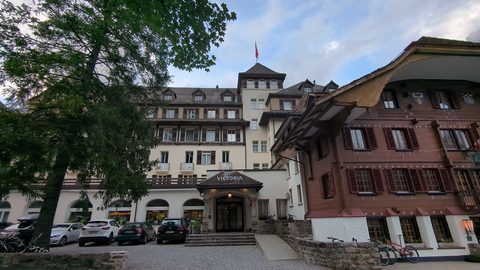
Twelve hotels operated in Kandersteg in 1914. Eight remain as hotels. The concentration on the main road, between the station and the church, is walkable in twenty minutes. Start at the Bernerhof, five storeys with a mansard roof, the clearest example of Belle Époque confidence in the valley. It was called the Grand Hotel Kandersteg until a later rebranding. Next door, the Victoria Ritter, built in 1893, has timber balconies on a stone ground floor. The Alfa Soleil, from 1896, faces south with a long veranda where guests took their afternoon milk cure. Further along, the Bellevue, built in 1907, uses Heimatstil timber cladding on its upper floors, a gesture toward local building traditions that the earlier hotels ignored. The Royal, from 1908, combines a stone base with timber above. The Waldhaus, also 1908, stands apart from the road in a patch of parkland, freestanding and surrounded by trees.
These buildings are not museums. They are working hotels. Book a room in any of them. The interiors have been modernised, but the bones the Belle Époque left are still there: the high ceilings, the wide staircases, the window proportions. The 1925 Blümlisalp, with its flat roof and reinforced concrete, marks the stylistic end of the era. It is the youngest building in the row and the least ornamental. After it, the First World War and the Depression stopped the building spree.
Eat Älplermagronen Above The Lake
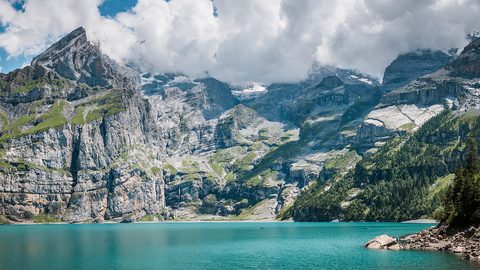
The hotel at Oeschinensee, opened in 1892 and rebuilt after an avalanche in 1930, sits at 1,578 metres above the village. It is the only Belle Époque building on the lake. You reach it by the cable car, which opened in 1948. The hotel still serves Älplermagronen with apple sauce on its terrace. The view across the turquoise lake to the sheer cliffs is exactly what the early visitors came to see.
The Gasterntal Relic You Must Plan Around
A Hotel With No Signal And A Seasonal Window
The most evocative remnant of Belle Époque Kandersteg is the Waldhaus in the Gasterntal. Built in 1908, it sits alone at 1,370 metres in a dead end glacial valley with zero phone signal. It was a cure hotel for the same clientele. It is isolated, timber built, freestanding in a meadow where the valley narrows to a gorge. It is also inaccessible for half the year. The single lane road to the Gasterntal closes to private vehicles from mid April to mid June, when the snow melts and the surface softens. The Waldhaus itself closes from late October to mid December. In winter, the road is closed to cars entirely; you can ski or snowshoe in. In summer, the road operates on a controlled timetable. Private cars are banned between 10:00 and 16:00 in peak months. You need a day permit, which costs roughly CHF 15 and is set by the municipality, and you must check the opening times before you go. The PostBus runs from Kandersteg station, but the last bus out can leave as early as 16:30. Miss it and you walk two hours back along the valley floor. No taxi operates here.
What To Do Once You Arrive
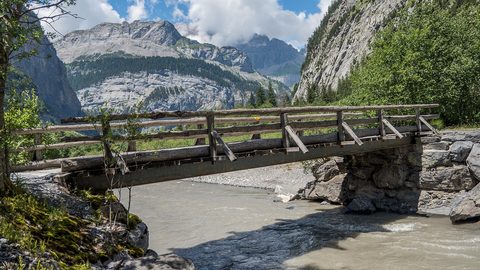
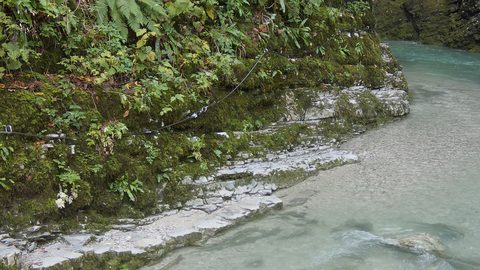
The Gasterntal suspension bridge, a wobbly wire span over the glacial river, is a short walk from the Waldhaus. The valley is a BLN protected area, object 1508. The Inneri Rütti farm, the last working alp before the valley narrows, still produces air dried beef sold at the Heimritz farm stand. Arrive by 09:00. Take cash. Swisscom has zero signal here; download the SBB timetable and offline maps before you leave Spiez.
What the Belle Époque Left Behind Beyond the Hotels
The Church, The Scouts And The Pines
The parish church was consecrated in 1511 but rebuilt in its current form in 1910, right when the hotel construction peaked. Its whitewashed walls and square tower sit at the village centre. The Kiental church, 1929, and the Reichenbach church, rebuilt after a 1927 fire, are later additions. The Kandersteg International Scout Centre, founded in 1923 on a 17 hectare meadow, occupies the same flat ground that the first hotel builders considered but did not buy. Walter von Bonstetten chose the location for the central north south route, the new railway line, and the availability of a large flat meadow. The centre now accommodates 1,200 beds and draws 12,000 visitors annually. It is not a Belle Époque building, but it is a direct consequence of the railway that made the valley accessible.
The Arven forest above the village, a stand of ancient stone pines rare in the Alps, was never logged by the hotel builders. It remains a short walk from the top of the Allmenalp cable car, which opened in 1962. The Allmenalp via ferrata, a vertical iron ladder route, uses the same cliffs that early English climbers from the Alpine Club, founded in 1857, first ascended.
The Climbers Who Came First
The first ascent of the Doldenhorn by Abraham Roth and guides in 1862, the Balmhorn by Frank and Lucy Walker in 1864, and the Oeschinenhorn in 1875 all started from this valley. The British climber Leslie Stephen, who first climbed the Blümlisalphorn in 1860, walked these trails. Edward Whymper came through in the 1860s. The guidebooks that brought them, Murray in 1838 and Baedeker from 1863, are the literary foundation of the Belle Époque tourism boom.
How the Valley Changed After the Belle Époque
The War And The Shift To Day Trippers
The Second World War collapsed foreign visitor numbers between 1939 and 1945. The Swiss army fortified the south portal of the Lötschberg tunnel and the Gemmi Pass defensive position. After the war, the pattern shifted. The long stay grand hotel guest, who arrived for six weeks in July, did not return. Short stay, self catering and day visitors replaced them. The number of hotels dropped from 12 in 1914 to 8 in 2023. The Oeschinensee cable car opened in 1948, the Sunnbüel cable car in 1957, the Allmenalp cable car in 1962. These made the high trails accessible to day trippers. The Gasterntal road opened to private vehicles in the 1960s, ending the valley's isolation by car.
What The Base Tunnel Changed
The 2007 Lötschberg base tunnel bypassed the old line, cutting Kandersteg's station traffic. Today the RegioExpress runs hourly to Bern in 64 minutes and to Spiez in 28 minutes. No international trains stop here. The village population in 2023 is 1,300, barely 100 more than in 1930. The hotel bed count is about 2,000, up from 1,200 in 1914, but the guests stay an average of three nights, not three weeks.
The second home cap of 20 percent of municipal housing stock, imposed by federal law Lex Weber in 2012, has frozen further development. Kandersteg cannot add more holiday apartments. What the Belle Époque built is what you get.

How to See Belle Époque Kandersteg in Three Days
Day One: Hotels And The Lake
You need three full days because the valley is linear and the side branches are dead ends. Each one consumes a full day and you cannot shortcut between them without returning to the valley floor. Start with the village hotels and the Oeschinensee. Arrive at the cable car before 09:00. The queue between 10:00 and 14:00 in July and August can exceed 90 minutes. Walk the lake circuit, eat at the Berghaus.
Day Two: The Gasterntal
Take the 08:30 PostBus from the station. Check the return schedule the moment you step off. Walk to the suspension bridge, have lunch at the Waldhaus if it is open, or bring food.
Day Three: The Gemmi Crossing
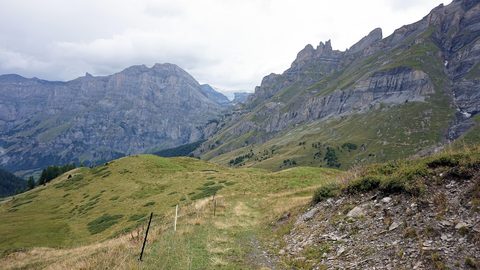
Take the Sunnbüel cable car, walk the historic mule track to the Daubensee and the Gemmi Pass at 2,270 metres. The crossing to Leukerbad is one way. Returning the same day requires a bus or taxi loop of about two and a half hours. Budget for that or leave a car at Leukerbad. The Gemmi route was the original Belle Époque arrival path; you walk it in reverse.
Avoid the mid April to mid June shoulder break and the late October to mid December closure window. Most cable cars and huts shut. The high trails stay snow covered or dangerously soft. July and August guarantee full operations. Late February to early March works for ski touring on spring snow.
Who the Belle Époque Relics Suit, and Who They Do Not
Kandersteg suits hikers who want high alpine trails without the Jungfrau crowds. It suits families with young children who need manageable lake walks and cable cars. It suits serious ski tourers and anyone who specifically wants to sleep in a mountain hut above the treeline. It suits travellers seeking silence rather than a scene. The Belle Époque buildings are quiet landmarks, not attractions with ticket gates. You experience them by walking past, by eating in their restaurants, by sleeping in rooms that still have the original window proportions.
It does not suit nightlife seekers, luxury shoppers, or anyone who wants a car free village centre with cobbled lanes. The valley is a collection of small separated pockets, not a single resort. The largest mistake visitors make is assuming they can see Oeschinensee, Blausee, the Gasterntal and the Gemmi in two days. You cannot. Each side branch consumes a full day. Plan three days minimum, check the seasonal closures before you book, and treat the PostBus schedule as fixed law rather than a suggestion.
Read next
-
 Oeschinensee
The turquoise Oeschinensee under sheer cliffs is the Kandertal's UNESCO centrepiece—here's how to beat the cable car queue and walk the full circuit safely.
Oeschinensee
The turquoise Oeschinensee under sheer cliffs is the Kandertal's UNESCO centrepiece—here's how to beat the cable car queue and walk the full circuit safely.
-
 Gasterntal
The Gasterntal is a dead-end glacial valley behind Kandersteg with a controlled single-lane road, no phone signal, and a historic timber hotel. Here’s how to get in.
Gasterntal
The Gasterntal is a dead-end glacial valley behind Kandersteg with a controlled single-lane road, no phone signal, and a historic timber hotel. Here’s how to get in.
-
 Sunnbüel und Gemmipass
The Sunnbüel cable car lifts you from Kandersteg to the start of the Gemmi Pass trail to Leukerbad. The walk is one-way, and the return loop takes planning.
Sunnbüel und Gemmipass
The Sunnbüel cable car lifts you from Kandersteg to the start of the Gemmi Pass trail to Leukerbad. The walk is one-way, and the return loop takes planning.
-
 Allmenalp
The Allmenalp cable car above Kandersteg serves a via ferrata, a climbing crag, and a paraglider launch. It’s not a general viewpoint, and it shuts in the shoulder seasons.
Allmenalp
The Allmenalp cable car above Kandersteg serves a via ferrata, a climbing crag, and a paraglider launch. It’s not a general viewpoint, and it shuts in the shoulder seasons.
-
 Kandertal Hotels and Mountain Inns Worth Booking
From the timber rooms of the Waldhaus in the Gasterntal to a dormitory bed at the Oeschinensee mountain hut, here are the Kandertal's real hotel options.
Kandertal Hotels and Mountain Inns Worth Booking
From the timber rooms of the Waldhaus in the Gasterntal to a dormitory bed at the Oeschinensee mountain hut, here are the Kandertal's real hotel options.
-
 Where to Stay in the Kandertal Valley for Hiking and Quiet
Compare the three places to sleep in the Kandertal—Kandersteg village, the Kiental farms, and the high hamlet of Griesalp—and find the right base for your hiking trip.
Where to Stay in the Kandertal Valley for Hiking and Quiet
Compare the three places to sleep in the Kandertal—Kandersteg village, the Kiental farms, and the high hamlet of Griesalp—and find the right base for your hiking trip.
-
 Things to Do in the Kandertal Summer Hiking and Winter Ski Touring
What there is to do in the Kandertal, split between summer hiking and winter ski touring, with the dead shoulder seasons clearly marked so you do not arrive to closed lifts.
Things to Do in the Kandertal Summer Hiking and Winter Ski Touring
What there is to do in the Kandertal, split between summer hiking and winter ski touring, with the dead shoulder seasons clearly marked so you do not arrive to closed lifts.
-
 Best Time to Visit the Kandertal and When to Stay Away
The Kandertal has two real seasons—high summer hiking and late-winter ski touring—and two long shoulder closures when the cable cars and huts simply shut.
Best Time to Visit the Kandertal and When to Stay Away
The Kandertal has two real seasons—high summer hiking and late-winter ski touring—and two long shoulder closures when the cable cars and huts simply shut.
-
 Getting Around the Kandertal Without a Car
The Kandertal runs on PostBuses with early last departures and no taxi backup. Learn the Gasterntal road rules, the SBB app, and why offline maps matter.
Getting Around the Kandertal Without a Car
The Kandertal runs on PostBuses with early last departures and no taxi backup. Learn the Gasterntal road rules, the SBB app, and why offline maps matter.