The Kandertal in Winter: Ski Touring, Cross-Country and Deep Seasonal Quiet
The Kandertal in winter is for ski tourers and cross-country skiers, not downhill resort skiers. Late October to mid-December is a dead window, and February to March is the real season.


The Kandertal in Winter: Ski Touring, Cross-Country and Deep Seasonal Quiet
The snow is gone from the valley floor by early April and the last cable car closes. That silence is not peace. It is the sound of a valley that has shut its doors. The Kandertal in winter is not one continuous season but three distinct windows. Miss the calendar and you stand at a closed gate.
The Dead Window That Defines Everything
From late October to mid-December the Kandertal sits in deep shade. The sun drops behind the Doldenhorn massif before 14:30 and does not return to the village until late February. Nothing operates. The Sunnbüel cable car is closed. The cross-country trails are not groomed. The bus schedule shrinks to a skeleton. Most hotels in Kandersteg close mid-October and do not reopen until mid-December. Arrive in early November and you will find a single supermarket, two empty streets and a locked valley.
The same thing happens again from mid-April to mid-June. The snow is too soft for ski touring and too deep for hiking. The cable cars close for their shoulder-season maintenance break. The mountain huts board up. Only the valley floor walking paths remain open, and they are wet, muddy and unsatisfying. The Sunnbüel ski area runs snow-dependent, and the shoulder before and after is a gamble. The Oeschinensee gondola runs in winter but closes on Mondays (non-holiday) and stops at Oeschinen station at 1,682 metres. It does not reach the lake. There is no lake access by lift in winter.
What is Actually Open and What is Not
The Sunnbüel Ski Touring Zone
The cable car up from Kandersteg runs from late December to mid-March, snow-dependent, and serves 10 kilometres of pistes: 4 km blue, 5 km red, 1 km black. The vertical drop runs from 1,400 metres to 1,930 metres. Lifts are one chairlift and two T-bars. This is not a destination for a week of downhill skiing. It is a base for ski tourers accessing the Gemmi Pass crossing. The viewpoint at the top faces the Doldenhorn massif and the terrace at the mountain station serves rösti with melted Raclette du Valais. That is the extent of the dining scene.
The Cross-Country Network
The valley floor holds 45 kilometres of prepared cross-country trails, classic and skating, running from Kandersteg through Blausee to Kandergrund. This is the most reliable winter activity because it does not depend on cable cars or snow depth at altitude. The trail network connects the village to the Blausee restaurant, which stays open daily in winter from 10:00 to 17:00. The three-and-a-half-kilometre sledge run from Kandersteg to Blausee operates on the same route. Two shorter sledge runs exist at Oeschinen (1.5 km, floodlit Tuesday and Friday evenings) and up at the Sunnbüel zone (1.2 km).
What Is Closed
The Gasterntal road closes to all vehicles from November to May, exact dates snow-dependent. That entire dead-end glacial valley with its suspension bridge, raw terrain and zero phone signal is unreachable in winter. The Griesalp road closes beyond the Griesalp junction. No through connection exists. The Oeschinensee high circuit, the Gemmi high path, the Allmenalp via ferrata and all high walking paths are closed. The ice climbing sectors at Kanderfälle, Oeschinenwald, the Gasterntal entrance and Ueschinen open from late December to late February and run from WI3 to WI6+. These are not beginner routes. They are multi-pitch alpine terrain accessed by approach skis or crampons, and the avalanche danger scale runs daily from the WSL Institute for Snow and Avalanche Research SLF, updated at 08:00 and again at 17:00 during high danger.
The February to Early March Ski Touring Window
Late February to early March is the peak season for ski touring, not for general winter tourism. The snow is stable. The days are longer. The spring snow on the Gemmi crossing holds until midday. Plan your ski touring trip for this window. Outside it, the snow is either too thin in December and January or too wet in late March.
January is the quietest month after 6 January. The Christmas holiday peak weeks run from 24 December to 2 January. The February school holiday peak weeks are weeks 6 to 8, varying by canton. If you want silence, arrive between 7 January and the last week of January. If you want snow reliability, aim for mid-January to late February.
Getting There and Getting Around
Fly into Bern (BRN) or Zürich (ZRH). From Bern, take the train to Spiez and change for the Lötschberg line to Kandersteg station at 1,176 metres. Total time is 60 minutes, full fare roughly CHF 35. From Zürich, train via Bern or Spiez, two hours and 15 minutes, around CHF 75. No airport bus serves the valley directly.
PostBus is the only public transport. Drivers do not sell tickets on board. Buy coins or load the SBB Mobile app before you board. The single biggest trip-up is the last bus leaving as early as 16:30, even in summer. In winter, with the Gasterntal road closed and the Griesalp road cut, the bus is irrelevant for those destinations anyway. But the principle holds: check the last departure time before you start any walk. There is no taxi backup.
The valley is linear but the side branches are dead ends. Each one consumes a full day. You cannot see Oeschinensee, Blausee, the Gasterntal and the Gemmi in two days. The common mistake is assuming you can shortcut between side valleys without returning to the valley floor. You cannot. Budget three full days minimum. The weather closes in fast and you need a buffer to hit at least one high-altitude objective.
Where to Eat and What to Drink
Après-ski in the Kandertal means a single unfiltered lager at a village restaurant. Kandersteger Bier is brewed in the village and served at the Hotel Alfa and the restaurant at the Sunnbüel mountain station. That is the extent of the party scene.
The serious meals happen at altitude. Älplermagronen with apple sauce at Berghaus Oeschinensee, eaten at 1,678 metres. Fresh trout from the Blausee organic farm at the lake restaurant. Rösti with melted Raclette du Valais up at the cable-car station. Dried air-dried beef sold from the farm at Heimritz, made in the Gasterntal. Wild berry tart with cream at the Griesalp hotel, the berries foraged on the alp. Carry cash. Many alp huts and the Griesalp hotel have no card terminals above 1,500 metres.
What to Wear and What to Carry
Waterproof winter boots with good tread. Crampons or spikes for icy sections. Poles with snow baskets. The winter walking path network covers 80 kilometres across Kandersteg, Kandergrund, Reichenbach and Kiental, marked with pink signposts and prepared only on designated routes. These routes avoid avalanche terrain. Shortcuts cross unassessed slopes. Do not take shortcuts.
Swisscom has 4G in Kandersteg village and at Oeschinensee. The Gasterntal and Griesalp have zero signal. Sunrise and Salt networks are patchy even in the valley. Download offline maps and the SBB timetable before leaving Spiez.


| Period | Status |
|---|---|
| Late October to mid-December | Deep shade. Nothing operates. Hotels closed. Cable cars closed. Cross-country trails not groomed. Avoid completely. |
| Mid-December to late December | Sunnbüel cable car opens snow-dependent. Cross-country grooming begins. Christmas peak weeks 24 Dec to 2 Jan. Busy at village level. |
| Late December to late January | Ice climbing season. Oeschinensee gondola open Monday to Saturday. January after 6 Jan is quietest month. |
| Late February to early March | Peak ski touring window. Spring snow on Gemmi. Best snow reliability. February school holiday weeks 6 to 8. |
| Mid-March to mid-April | Sunnbüel closes mid-March snow-dependent. Soft snow. Shoulder season. Most huts close. |
| Mid-April to mid-June | Cable cars closed for maintenance. High trails snow-covered or dangerously soft. Avoid. |
The Oeschinensee Ice Risk
The frozen surface of Oeschinensee forms from January to early March. Do not walk on it. Avalanche debris zones cover the lake surface. Thin ice sits near inflows and outflows. No official crossing route exists. The lake is beautiful from the shore and dangerous on the surface. The winter walking path is open only to Oeschinen station at 1,682 metres, not to the lake itself.
Who This Valley Suits and Who it Does Not
The Kandertal in winter suits serious ski tourers who want the Gemmi crossing without crowds, cross-country skiers who need 45 kilometres of prepared trails, ice climbers working WI3 to WI6+ routes, and travellers who want silence rather than a scene. It suits hikers who understand that the high trails are closed but the valley floor walking paths cover 80 kilometres. It suits anyone who can handle a three-day minimum stay with a weather buffer.
It does not suit nightlife seekers. It does not suit luxury shoppers. It does not suit anyone who expects a large interconnected ski circus with dozens of lifts. It does not suit visitors who want a car-free village centre with cobbled lanes. The valley is a collection of small, separated pockets, not one continuous resort. The single thing that most often goes wrong: arriving in the dead window or assuming you can see three side valleys in two days.
Read next
-
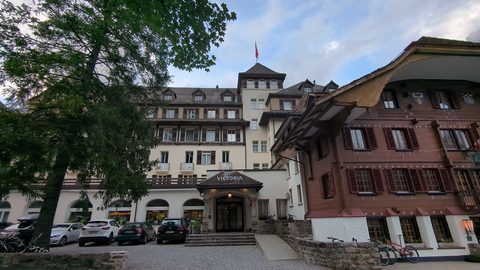
 Kandertal Hotels and Mountain Inns Worth Booking
From the timber rooms of the Waldhaus in the Gasterntal to a dormitory bed at the Oeschinensee mountain hut, here are the Kandertal's real hotel options.
Kandertal Hotels and Mountain Inns Worth Booking
From the timber rooms of the Waldhaus in the Gasterntal to a dormitory bed at the Oeschinensee mountain hut, here are the Kandertal's real hotel options.
-
 Where to Stay in the Kandertal Valley for Hiking and Quiet
Compare the three places to sleep in the Kandertal—Kandersteg village, the Kiental farms, and the high hamlet of Griesalp—and find the right base for your hiking trip.
Where to Stay in the Kandertal Valley for Hiking and Quiet
Compare the three places to sleep in the Kandertal—Kandersteg village, the Kiental farms, and the high hamlet of Griesalp—and find the right base for your hiking trip.
-
 Things to Do in the Kandertal Summer Hiking and Winter Ski Touring
What there is to do in the Kandertal, split between summer hiking and winter ski touring, with the dead shoulder seasons clearly marked so you do not arrive to closed lifts.
Things to Do in the Kandertal Summer Hiking and Winter Ski Touring
What there is to do in the Kandertal, split between summer hiking and winter ski touring, with the dead shoulder seasons clearly marked so you do not arrive to closed lifts.
-
 Best Time to Visit the Kandertal and When to Stay Away
The Kandertal has two real seasons—high summer hiking and late-winter ski touring—and two long shoulder closures when the cable cars and huts simply shut.
Best Time to Visit the Kandertal and When to Stay Away
The Kandertal has two real seasons—high summer hiking and late-winter ski touring—and two long shoulder closures when the cable cars and huts simply shut.
-
 Getting Around the Kandertal Without a Car
The Kandertal runs on PostBuses with early last departures and no taxi backup. Learn the Gasterntal road rules, the SBB app, and why offline maps matter.
Getting Around the Kandertal Without a Car
The Kandertal runs on PostBuses with early last departures and no taxi backup. Learn the Gasterntal road rules, the SBB app, and why offline maps matter.
-
 Kandertal Itineraries for Two Days Four Days or a Week
Plan your Kandertal days around the reality that each side valley takes a full day and you cannot shortcut between them—here are itineraries for two, four and seven days.
Kandertal Itineraries for Two Days Four Days or a Week
Plan your Kandertal days around the reality that each side valley takes a full day and you cannot shortcut between them—here are itineraries for two, four and seven days.
-
 Kandersteg
 is the head of the Kandertal and the launch point for Oeschinensee, the Gemmi Pass and the Gasterntal. Here is what you reach from it.
Kandersteg
Kandersteg is the head of the Kandertal and the launch point for Oeschinensee, the Gemmi Pass and the Gasterntal. Here is what you reach from it.
-
 Reichenbach im Kandertal
 is the valley mouth where the road splits for Kandersteg or the Kiental. It is a junction, not a destination in itself.
Reichenbach im Kandertal
Reichenbach im Kandertal is the valley mouth where the road splits for Kandersteg or the Kiental. It is a junction, not a destination in itself.
-
 Kandergrund
 is a string of hamlets along the Kandertal road, anchored by the Blausee and overlooked by the Lötschberg railway ramp climbing to the tunnel.
Kandergrund
Kandergrund is a string of hamlets along the Kandertal road, anchored by the Blausee and overlooked by the Lötschberg railway ramp climbing to the tunnel.